Central Maine General Hospital
'Salem's Lot: A NovelCentral Maine General Hospital is the institution to which Danny Glick is taken after collapsing during the search for his missing brother. It initially frames the crisis as a medical problem—emotional shock, abnormal physical reactions, and diagnostic testing—yet its clinical language cannot account for what is happening. The hospital therefore becomes one of the novel’s important thresholds between ordinary civic life and the hidden vampire outbreak in Jerusalem’s Lot.
Setting and Institutional Function
Central Maine General Hospital stands outside Jerusalem’s Lot as part of the wider regional infrastructure that responds when the town’s own explanations fail. After four days of fruitless searching through the wood lot, Taggart Stream, and the Royal River, Danny collapses in an upstairs hallway at four o’clock in the morning. An ambulance carries him to the hospital, where the case is immediately absorbed into professional medical procedure rather than local rumor.
The institution’s significance lies in this movement from private terror to public diagnosis. Danny’s parents arrive with a missing child and a frightened family history; the hospital receives a patient whose condition must be described through symptoms, tests, and institutional supervision. The contrast reflects the novel’s broader pattern: familiar systems remain active and apparently competent even while an older, less intelligible evil is entering the town.
Danny Glick’s Hospitalization
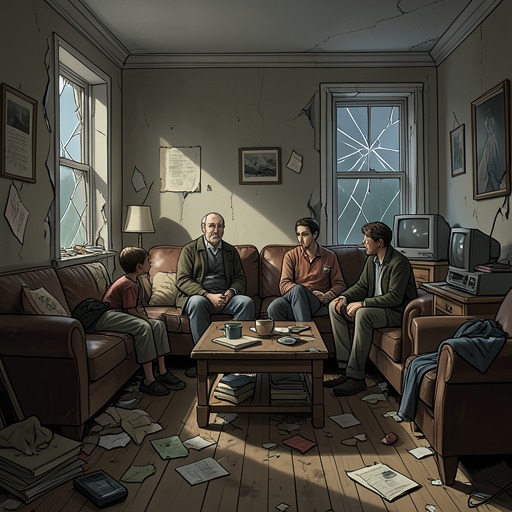
The preliminary diagnosis for Danny is severe and delayed emotional shock. This interpretation is understandable within the circumstances. He has disappeared, the search has failed, and his parents have spent days moving through woods and fields calling his name. The diagnosis thus treats his collapse as the delayed bodily consequence of terror and exhaustion rather than as evidence of an external supernatural assault.
The doctor in charge, Gorby, questions Tony Glick about asthma attacks, abnormal bleeding, bloody noses, bloody stool, scrapes, and bruises. Tony denies these symptoms. Gorby then proposes continued observation and testing, including X-rays, a marrow test, and a white count, while noting that Danny’s reactions are very slow. Tony agrees to the hospitalization and mentions his Blue Cross coverage, an ordinary detail that anchors the scene in recognizable mid-century medical life even as the patient’s condition begins to exceed ordinary medicine.
Danny’s entry in the hospital records is dated September 23, 1975, under the name Daniel Francis Glick, with an address on Brock Road in Jerusalem’s Lot. The formal record fixes the episode in time and converts a family catastrophe into an administrative case. That precision intensifies the horror rather than dispelling it: the institution can identify the patient, date the admission, and organize tests, but it cannot identify the force acting upon him.
Medical Knowledge and the Supernatural Crisis
The hospital represents a mode of interpretation that repeatedly competes with the vampire explanation. Symptoms are examined as possible signs of asthma, bleeding disorders, emotional shock, or other physical disease. This diagnostic vocabulary delays recognition of the true danger because it assumes that the body’s abnormality belongs to a known medical category.
The same tension reappears when James Cody examines Mike Ryerson’s corpse after it is found in Matt Burke’s guest room. Cody observes that the body resembles the condition associated with Danny: there is no surface lividity and no sign of rigor or incipient rigor. Later, the body of Marjorie Glick is examined in Green’s workroom, where Jimmy Cody again notes the absence of normal postmortem changes and compares her condition with Mike Ryerson’s. These scenes extend the hospital’s function beyond its walls. Medical observation becomes an instrument for detecting that the town’s dead are not behaving like ordinary corpses, even though the doctors do not initially possess a supernatural vocabulary for the evidence.
The discovery that bodies have been stolen from the Cumberland County Morgue in Portland widens the crisis from one patient to a regional threat. The morgue is not Central Maine General Hospital, but the theft confirms the same institutional problem: official systems can register death and preserve bodies, yet they cannot guarantee that the dead will remain contained. The hospital’s normal procedures therefore acquire an ominous counterpart in the removal, return, and altered condition of corpses.
Place in the Town’s Network of Violence
Central Maine General Hospital belongs to the network of places through which the Glick family tragedy becomes public. Danny’s collapse follows Ralphie Glick’s disappearance and the failed search; the hospital then becomes the setting in which the family’s grief is translated into medical observation. The movement is from woods, to ambulance, to ward, and eventually toward the wider investigation of unexplained deaths.
That network is supported by Jerusalem’s Lot’s culture of collective memory and secrecy. The town was incorporated in 1765 and celebrated its bicentennial with fireworks and a pageant, yet its communal identity also preserves older horrors. The scandal surrounding the Marsten House has been passed ceremonially from generation to generation, while other crimes remain concealed beneath rumor, inherited stories, and incomplete records. Against that background, the hospital offers the appearance of transparent knowledge: names, symptoms, tests, and dates. But the novel repeatedly shows that documentation does not equal understanding.
The hospital’s surrounding world is also shaped by the town’s capacity to keep secrets. Residents know fragments of old violence without knowing its full causes, including the truth behind Hubert Marsten’s murder of Birdie Marsten and the unexplained disappearance of four children between 1928 and 1939. Central Maine General Hospital cannot solve those buried histories. Its role is more limited and more revealing: it records the new symptoms through which the old evil returns.
Narrative Significance
Central Maine General Hospital is significant because it marks the point at which supernatural violence becomes legible as illness. Danny’s collapse is not treated as an immediate vampire attack but as delayed emotional shock; his slowed reactions lead to tests rather than exorcism or armed resistance. The hospital thus embodies both the strength and the limitation of modern knowledge. It can observe, classify, and preserve evidence, but it initially mistakes the nature of the threat.
The institution also gives the outbreak a material and bureaucratic reality. A child has a name, an address, an ambulance, a physician, insurance coverage, and a series of proposed tests. Those details make the supernatural invasion more disturbing because it does not replace ordinary life at once; it moves through ordinary life’s procedures. Central Maine General Hospital is where a family’s private terror becomes an official medical case, and where the novel’s central conflict between clinical explanation and vampiric fact first acquires institutional form.